Postmenopausal bleeding is defined as any vaginal bleeding that occurs 12 months or more after your last menstrual period. This includes not just heavy, period-like flow, but also any spotting, pink or brown discharge, or blood-stained vaginal discharge.
It is not a condition, but rather a warning sign from your body that the lining of your womb (endometrium) may be undergoing some change. The BGCS guidelines recommend prompt evaluation, starting with a transvaginal ultrasound (TVUS), as this is the most effective first-line tool.
Who Does It Affect?
PMB can affect any woman who has passed the menopause. However, the risk of underlying endometrial cancer increases with age, particularly with the rising prevalence of obesity and metabolic syndrome — both being established, independent risk factors for the disease.
What Are the Possible Causes?
- Vaginal Atrophy (Atrophic Vaginitis/Bleeding): The most common cause. Due to falling oestrogen levels after the menopause, the vaginal walls become thinner, drier, and more fragile, easily bleeding.
- Endometrial or Cervical Polyps: Benign fleshy growths protruding from the womb lining or cervix.
- Endometrial Hyperplasia: A non-cancerous thickening of the womb lining; if it includes atypia, it may be considered a precancerous condition.
- Endometritis or Cervicitis: Inflammation or infection of the womb or cervix.
- Uterine Fibroids: If you have retained fibroids from your reproductive years, they may occasionally cause bleeding after the menopause as they degenerate.
- Trauma: Frequent cause of spotting or light bleeding, often related to sexual intercourse.
- Endometrial Cancer: The lifetime risk is approximately 2-3%, but among women presenting with PMB, approximately 5-10% will have endometrial cancer, and this rises to 13% over the age of 60.
Recommended Diagnostic Pathway
- History and Clinical Assessment
- A full pelvic examination will be performed to assess the vulva, vagina and cervix and to rule out any cervical or vaginal sources of bleeding.
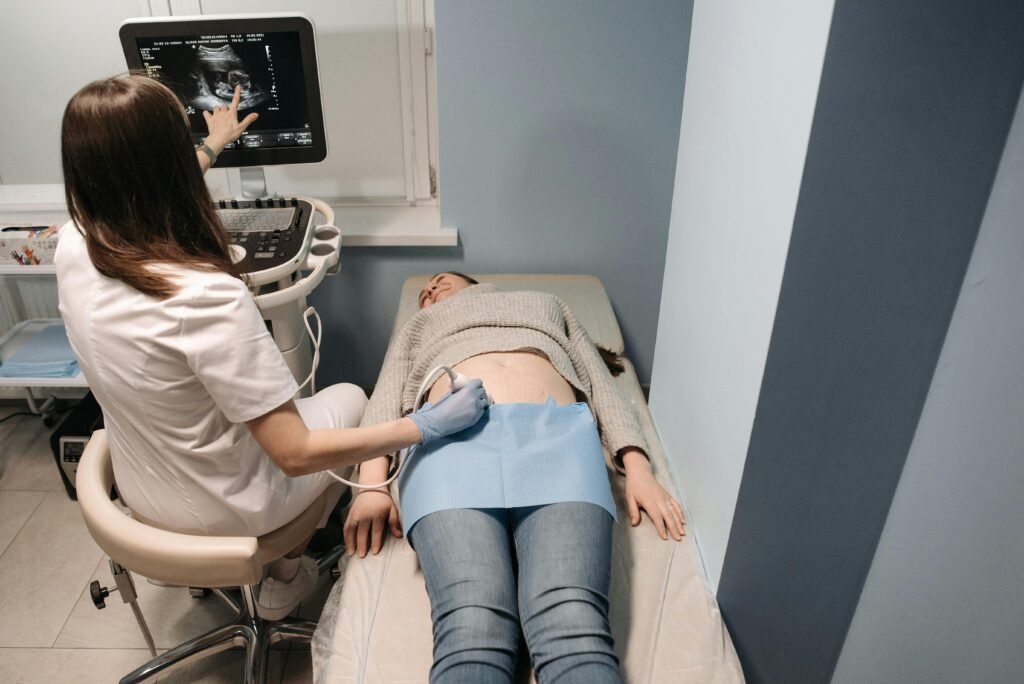
- Transvaginal Ultrasound (TVUS) – This is a simple, non-invasive scan (a small ultrasound probe placed in the vagina) that provides an accurate measurement of the endometrial thickness (ET). It allows for a highly accurate rule-out test depending on the cutoff value. An endometrial thickness of 4 mm or greater should be followed by endometrial sampling using an outpatient biopsy (e.g. Pipelle) or hysteroscopy.
- Outpatient Hysteroscopy with Directed Biopsy – A very thin (3-5 mm) telescope (hysteroscope) is passed through the cervix into the uterine cavity, allowing the gynaecologist to directly visualise the entire cavity lining and any polyps, fibroids, or suspicious areas. Directed biopsies can be taken from any suspicious area under direct vision.
Frequently Asked Questions (FAQs)
Q: I have just started spotting after 10 years without a period. How urgent is this?
A: Very urgent. You should attend gynaecological appointment without any further delay to rule out the possibility of endometrial cancer.
Q: I am on HRT and this is my first spotting episode after 8 months of use. Do I need to worry?
A: No, you should not be unduly alarmed early on. However, you must inform your doctor, and they will advise you on the appropriate monitoring: any persistent or heavy bleeding requires investigation, typically with a TVUS and possibly a biopsy.
Q: My ultrasound showed my endometrial thickness was 3.5 mm. My GP says I don’t need a biopsy. What does this mean?
A: This is generally excellent news. A thin, smooth endometrial lining measuring less than 4 mm in a woman not on HRT is strongly reassuring against the presence of endometrial cancer.
Q: What is an inadequate Pipelle sample, and what happens then?
A: An inadequate sample means the Pipelle device did not obtain enough endometrial tissue to allow a pathologist to conclusively rule out pathology. In such cases, you will be offered a repeat biopsy under ultrasound guidance or an outpatient hysteroscopy with targeted biopsies.
Q: Are there any new tests for endometrial cancer that might avoid a biopsy?
A: Yes. A new epigenetic test called WID-Easy, a simple cervicovaginal swab (like a smear test) that analyses DNA methylation patterns associated with endometrial cancer.
eGynaecologist Advice
- Postmenopausal bleeding must always be taken seriously, but it is equally important to understand that in most cases, it is not cancer. If you experience any bleeding after going through the menopause, you must contact your gynaecologist.
- It is imperative that you complete the investigations following post-menopausal bleeding and at any stage if you have further bleeding you must contact your gynaecologist for further advice.